Showing posts with label Science. Show all posts

Friday, 12 June 2026

Terrific Teeth!


Year 4 have enthusiastically begun their new Science topic on the digestive system. This week, they focused on learning about teeth, including the different types of teeth and their important functions. Working collaboratively in pairs and using their reciprocity skills, the children created models of the bottom set of teeth using playdough before carefully labelling each type of tooth. They also discovered fascinating facts about teeth and discussed the importance of good dental hygiene and how to care for their teeth to keep them healthy. Well done, Year 4, for your excellent teamwork and scientific learning!


I enjoyed designing my partners teeth, I had to look carefully at each tooth - Mavis

Molars are the strongest teeth. - Alfie

We learnt about molars, incisors and canines. - Chirag

Super Scientists in Year 3


Super Scientists in Year 3

This week, our Year 3 scientists turned the classroom into a living laboratory as they kicked off an exciting new investigation! To dive deeper into how plants compete for resources, we are tackling the big question: "Does the number of seeds within one plant pot affect the growth of the plants?"

Each child has carefully planted their sunflower seeds, with some pots housing a single seed and others containing a small cluster. Over the next four weeks, the children will take on the role of dedicated researchers—observing, measuring, and recording the height and health of their sprouts. It’s a fantastic way for them to practice fair testing and data collection. We can’t wait to see which sunflowers reach for the sky first and what this teaches us about the space and nutrients plants need to thrive!


Tuesday, 2 December 2025

Sensational Science in Year 4


 This week in Year 4 we built great resilience by observing how matter changes states, which requires patience and focus! We used our resourcefulness to see condensation clearly by breathing on cold windows. Our teachers demonstrated boiling by safely heating water to create water vapour. We were reflective about the processes of melting and freezing, using reciprocity to discuss our scientific findings and observations.


"boiling requires bubbles and condensation is what that wet stuff on windows is called" Tommy, Elm

"Condensation is the opposite of evaporation." - Noah, Willow

"I have never thought about how closely these states of matter link before. " Finley, Maple


Friday, 10 October 2025

Super Science in Year 4


 This week, our Year 4 children swapped their classroom desks for the great outdoors as they brought their science learning to life in a fun and practical way! As part of their topic on classifying animals and plants, the children ventured outside to explore and engage with the natural world around them.

Once outside, the children worked in small groups to collect a variety of leaves, flowers, and plants from the school grounds. This hands-on approach allowed them to apply their growing knowledge of classification — looking closely at different characteristics such as leaf shape, colour, texture, and petal number.

Throughout the session, the children showed fantastic use of their reciprocity and resourcefulness skills. They listened to each other’s ideas, shared tasks, and worked as a team to ensure they gathered a wide range of specimens. It was a brilliant opportunity to practise collaboration and problem-solving in a real-world setting.

Once their collections were complete, the groups moved on to the next exciting task: creating their own classification tables… with chalk! Using the playground surface as their canvas, the children worked together to sort and organise their finds into categories. With creativity and scientific thinking on full display, the playground soon transformed into a colourful outdoor science lab, filled with chalk-drawn grids, labels, and carefully placed leaves and flowers.


It was fun collecting different plants and leaves and making a classification key - Noah and Sophia

You have to use closed questions for a classification key - Iustin

We worked together to collect enough materials to use in our classification key - Aisosa


Friday, 11 July 2025

Year 3 Visit Colchester Zoo!


On Tuesday, Year 3 had a wonderful day seeing all of the different animals at Colchester Zoo. 

First, the children had to decide within their groups which animals they would like to see and come up with the best route to take around the zoo. Then, we set off in our groups to find all of our favourite animals whilst learning lots of new and exciting facts along the way!

The children all got to have an up close and personal experience with the goats, and had the opportunity to feed and stroke them as they walked through the enclosure, this took resilience for some children, who had never experienced a large animal so close before. There was so much to do whilst at the zoo, including taking the zoo train into the lemur enclosure and feeding the parrots in the giant bird house! 

We finished the day with a lot of tired, but very happy children!


 My favourite part was being inside the tunnel and watching the sea lions - Loui, Ash Class


Seeing the elephants was amazing - Tommy, Cherry Class


Seeing the turtle was amazing - Success, Cedar Class

Friday, 20 June 2025

Super Science in Year 3


Super Scientists

This half term, the children will be observing the growth of some sunflowers to answer the scientific question 'Does the number of seeds within one plant pot affect the growth of the plants?'

First, the children worked together in small groups, applying their reciprocity sills, to add some compost to a small plant pot before planting the seeds. 

In the first pot, they planted one sunflower seed. 
In the second pot, they planted two sunflower seeds. 
In the third pot, they planted four sunflower seeds. 
In the final pot, they planted 8 sunflower seeds.


The children then used their resourcefulness skills to measure the water in a measuring cylinder, and added the same amount to each plant pot, before putting them in a sunny spot. 

Bentley said 'We will water and care for the plants every day!'

It was important for the children to understand what we were keeping the same in the test and what we would be changing, to ensure that the test was a fair one that delivered accurate results. 

Kylie said 'Sunflowers grow tall so they will need lots of water!'

The children kept the pots, amount of water and sunlight, mass of compost and brand of sunflower seeds the same, but they changed the amount of seeds in each pot. 

Kai said 'The sunflowers are growing so fast because it is hot and sunny!'

It has been wonderful to see the children checking the plants every morning, to monitor their growth. Each week in our science lessons, we will use a ruler to measure the growth of the plant in cm and by the end of our experiment, the children will discuss their results and form their own conclusions. We look forward to finding out the answer to our scientific question for this final half-term in Year 3! 

Have a wonderful weekend and we look forward to seeing you again on Monday.


Friday, 14 March 2025

Year 4 Celebrate Science Week!


The classroom has been buzzing with the celebration of the British Science Week! This year's theme is 'Change and Adapt'.

The children discussed ways in which the world around us changes and adapts.

Using yoga poses, they explored what animals, such as starfish and penguins, do to adapt to their environments and help them survive.

Whilst exploring the theme further, children considered playground games that they currently play or once played and thought of what adaptations would be made to allow these games to be inclusive.


There is an ongoing discussion within our school community concerning the health of the world around us and our part in it all. The children conducted an experiment using a water bottle and a range of materials e.g. tissue paper, green paper towels, wipes and A4 paper. 

'I predict that the wipes will not disintegrate in the water because it is thick and can last in water' — Jasmine, Elm
"I can't believe how much change is around us andhow so many things do adapt including humans and animals or plants... the world has adapted too" Callissya, Willow

They placed the chosen material into the water bottle and shook it for 15 seconds. The observations proved that tissue paper disintegrated with more ease than all the other materials , with the wipes being the most durable.

After exploring these areas of change and adaptations, it was very encouraging to see the drive and ambition in some of our children who dream of following a career path that will be part of the change in our world e.g. environmental scientists, occupational therapists and water quality technicians.


Science Week - Change & Adapt


It's British Science Week and the children have been celebrating by completing activities based on the this year's theme 'Change and Adapt'.

We started our activities by considering whether every playground game is accessible for all and how we can adapt these games to include everyone. We then worked in groups and designed our own inclusive playground games. 


Next, we conducted an experiment to decide which items had the correct properties to be flushed away.  The children used materials such as white paper and green towel and observed what happened to the materials once they were placed within a bottle of water. 

Finally, the children created a poster on the theme of Change and Adapt. It was fantastic to see so many colourful and interesting designs. Well done Year 3!

Monday, 24 February 2025

Science Week 2025! Calling all students!


On the 10th - 15th March the children are going to be taking part in Science week. This week is lots of fun and the children have a great time exploring  and learning all about Science. 

This years theme is Adapt and Change. So we are asking all children to bring a plastic bottle to complete activties and learning within their year group. If you have any extra bottles to share we would be extremely grateful.

Could all bottles please be in school the week commencing the 3rd March. 

Thank you for your continued support, 

The Science Team 

Friday, 14 February 2025

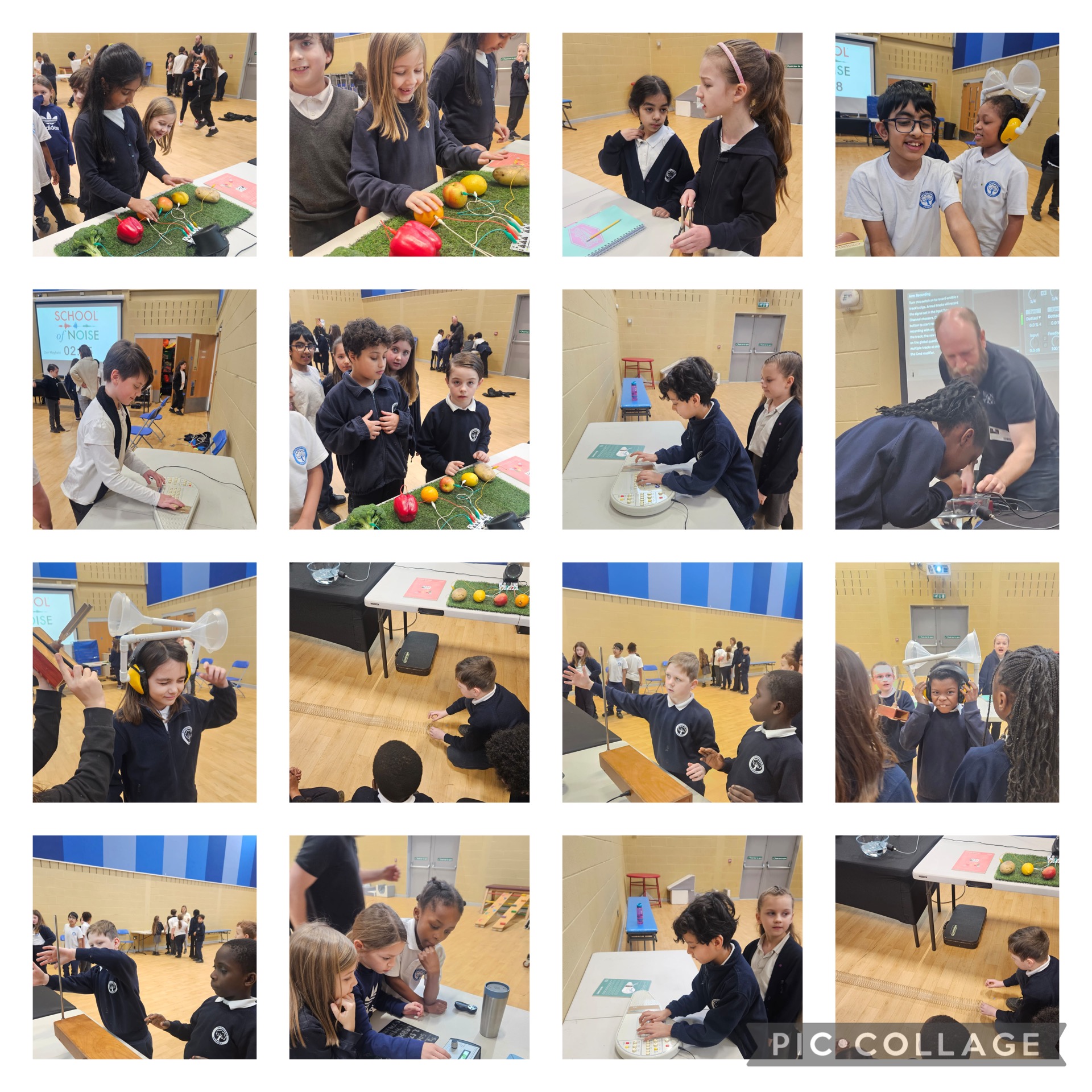
Year 4 School of Noise Workshop


This week, Year 4 were lucky enough to welcome the School of Noise workshop into school.

This workshop links with our learning Science and Music learning this half term.

The children explored ways that sound travels and how vibrations are made. 


"Wow I didn't realise sound travels through vibrations" - Sultan

The children went around different stations and explored different instruments School of Noise had brought in for them to try.


Thursday, 9 January 2025

Super Scientists!


In Year 3 this week we began our new science topic - Fossils!

We learnt that a fossils is the remains or trace if a thing that lived a long time ago and were able to group different fossils using a range of properties, such as colour, size and the type of remains. 

In the lesson we had the opportunity to touch and discuss a range of real fossils! We all had a go at identifying what we think each fossil may have been when it was alive. Finally, we each picked one fossil and used our resourcefulness skills to draw what we think it would have looked like when it was alive! 

Great scientific observations Year 3! 


"I loved drawing what I predict the animal would have looked like. It was so fun to use my imagination." - Noah, Cedar 

" The shark tooth was so cool. It was great to hold a real tooth!" - Roza, Cherry 

"Ammonite looks like a snail!" - Noah, Ash


Thursday, 7 November 2024

Super Science!


Food waste is our new topic in Science, for Autumn 2. To immerse the children into this, they began by sorting pictures of food waste into two different piles. The first pile contained waste that could be recycled and the second pile contained waste which should be put into landfill, Using their resourcefulness skills to make links in their learning and their reciprocity skills to work together, the children had a great time sorting all of the pictures!


The purpose of the lesson was to introduce our new topic vocabulary and to understand what food waste is and how to dispose of food appropriately.


'I know that food waste is when you throw away food that you can eat.' - Jacob


'Orange peel can be recycled.' - Moyo


‘We can recycle many things and make them into something new, such as compost’ - Onyeka

Monday, 14 October 2024

Super Science!


The children have been having a fabulous time in their Science lessons since beginning the new topic, Diet and Nutrition. 

We have spent time investigating different food groups and sorting foods into the correct group. We have looked at how much of each food group we should include in our diet and examined why too much or too little of each food group could be unhealthy for us. 


‘I loved moving around the room and putting the pictures with the right label’ - Munsha

'I know that eggs are a protein.' - Jaabir

'It was so much fun grouping the foods.' - Alfie

Friday, 14 June 2024

Super Science!


This week, the children in year 3 were super scientists!

We began by discussing everything that a plant needs to grow. The children then looked at some scientific equipment on the table and discussed what they thought it could be used for. The children were introduced to their activity for the next few weeks. They were told that they would be planting sunflower seeds and that they would be monitoring their growth in different conditions. 

Let's see our super scientists in action...
I predict my flower will grow tall because I will water it - Kayden

I predict my flower will grow because It will have lots of sunlight - Adam


I predict my flower will be the tallest because I will have lots of nutrients - Maya-Aisha